Thursday, March 23, 2017

I love to learn and try different things.

 
Spring Flowers


WeRelate.org is a wiki genealogy website, that provides genealogy tools and data. It bills itself as the world's largest freely licensed genealogy wiki, with almost 5 million wiki pages. Its information is free, and the site is non-commercial and nonsectarian. ... The site runs on the MediaWiki software.

I recommend that before you enter any information into this database, you look and read the “Home Page”. There are tutorials and you could just jump right in, but why not do yourself a favor and watch the tutorials?!!

Articles and/or reviews abouthttp://www.werelate.org:


WeRelate.org is the world’s largest genealogy Wiki.


Sunday, March 12, 2017

A Five-Point Formula for the GPS

Christine Rose, in her book Genealogical Proof Standard: Building a Solid Case, discusses how all five points must be applied to successfully build your case.  Are you familiar with the five points?  

There are resources available in periodicals, in blogs, in books, and on the Internet.  Explore and educate yourselves so that others will accept that you are a serious genealogist, but more importantly, so that you will prove your research and know that your ancestors are yours! 


Friday, March 10, 2017

Look forward but keep marching.

We are the family historians, by choice or by default.  Ours is the task to ferret out our ancestors and tell their stories. 

How will we accomplish this vast assignment? 

The Genealogy Community will help!  Continue to reach out for the "breaking news" of family history.  You can use this news to lift you up when you are discouraged. 

The news will also stir your concerns and prick your conscience and you may have to save a cemetery or preserve a record that is about to be discarded; you may have to mingle with bureaucrats and lobbyists, with agents of governments small and large--the destruction of our history, of our family's history may be in peril.

We have talked of bloggers in genealogy.  Share your stories, help your neighbor, or write a blog for your family members or others.  Read the blogs of Dick Eastman and others.  Let them know you are interested in our future, our present, and our past as it pertains to growing and knowing our family tree and the family tree of mankind.  The concept is that once you realize you are related to your neighbor, town folk, etc., you will treat each other more kindly.  We will treat each other like family members ought to be treated. 

Now, before I get too carried away:

Those of you who have put your family tree on FamilySearch.org have an opportunity to participate in Relative Finder in conjunction with the other members of this class.  This isn't a closed group, but it's a seed that will be allowed to sprout.  It will stir your imagination and inspire you to get busy, stay involved and continue to gather not just facts about your kin, but also learn about their culture, their time, their challenges and their joys.  If it wasn't for them, we wouldn't be here.

Again, I digress!

I have formed a group, with the help of Marvin Cochrane and Ed Pfeiffer and of course, my sorta sidekick, Val Moreland.  This group is called CLL Genealogists.  This group is represented at Relative Finder, online.  If, and/or when you put your ancestral tree on FamilySearch, you can join this group.  The results will be posted for you to see who and how you are related to each other and to famous or notable people.  You may personally invite other genealogists to join, in your family, or whatnot.  You can form your own family group, you can form a church group, or whatever.  The invitational url will be posted today in class.  We will not invite the internet to join because I manage this group and I don't want to have to work too hard!  Talk to you later, friends.  E-mail me if you forget or lose the invite URL.  Oh, and there is a password, also.  I want this group to be meaningful to you, or relative as they say.

Friday, March 03, 2017

Next Friday (last day of CLL): Stump the Chumps.  Time to ask those questions about genealogy methodology.  

Examples:
  • How do I find my ancestor's World War I Draft Registration?
  •   What is the key to finding out who my ancestor was and what he went through in his life?
This is not a brick wall session.  No time in class to do that, but if you need research guidance in general, this is the time to let loose!

One of five people who has most influenced the direction I've gone in my Family HIstory quest.  Megan Smolenyak, "Honoring Our Ancestors".

Why I admire Sally Fields and how that is pertinent to my life as a genealogist:
1.  She is persistent.
2.  She forges ahead against all odds.
3.  She aims high.

Dick Eastman: Genealogy News Guru.  "98% of the records you need": 


 Reading Dick Eastman's Genealogy Newsletter (he also does the news about technology) has been a wonderful education
for me every week.  #2 Influential person in 
my genealogy life. 

Stay posted.  More to come.  Watch this 
blog and win a prize next week!

Saturday, January 28, 2017

Next Friday's Class (Last Half)


FamilySearch.org is a nonprofit, (no subscription needed), website.  It is associated with the Family History Library in Salt Lake City.  

This website will be the topic of the last half of our class next Friday.  You can get ahead in the discussion if you go ahead and get a free account.  Feel free to explore some of the different sections (menu items on navigation bar) or search for some of your ancestors.

Don't be fearful, there is help galore.  Check out YouTube.com and Amazon Books.


Wednesday, January 25, 2017

Family History is so much more than genealogical research

Family History is an umbrella. 
Many types of information fall under that umbrella.  

Researching the genealogy (names, dates, and places) is certainly the foundation of our research.  However, stories, photographs, relics, and family traditions also increase our knowledge.  

We each have a unique view of our own personal history and of our family history.  This is the reason that my brother might remember a particular story differently than my sister and I remember it.  

When a detective looks for an eye witness, does he just look for one person's account or is he interested in what several witnesses might have seen?  The more information that can be gathered, the better the anaysis will be.  The more light you put on the subject, the more that details will show up.

We have to share our stories and compare our accounts with others' accounts.  A beautiful flower is seen in a photo.  Who is holding the flower?  What was the occasion?  The more we look and listen and ask questions--these are the things that sometimes reveal a slice of history in its clearest light.  Here are some links that will further this theme more deeply.


Thursday, January 19, 2017

Gather, Find, Prove

First Day of Class “Family History on the Internet”: Discussions for Friday 


1. Handouts: I will e-mail you copies of any handouts that I make up. I will also post it on my website. If you don't have a printer and still want a paper copy of something, I suggest you put the document on a flash drive and take it to Office Depot or Kinko's; you can even send them the docs via the Internet and then go pick them up.

2. Jon Shepherd will be helping me this session with the class. I've asked him to share his experiences with you as an Ancestry.com user, his insights on Findagrave.com, and more. I will be focusing on FamilySearch.org, strategies of researching on the Internet, and sharing some insight into learning the skills of research. Or not! You are the stars of this search and where you need help and ideas, we will strive to address some of those concerns. We sure can't do everything in 8 weeks, but maybe we can hit some of the things that will help you with finding your family either on the Internet or we can use the Internet to tell us where to look.
------------------------------------------------------------------------------------------------------------------------------

Some of the elements of researching that we will discuss in class will have to do not only with gathering the information about your family, but also analyzing the evidence and evaluating the various documents or other types of proof.

Here is a document.  Tell me what you learn from this "clue":  


 Is it just as important for you to cite your internet sources as it is a source a book?  What is the best way to do that?  How can you keep up with all the records you find when you are using the Internet as a tool.  First, gather these finds.  Put them in a notekeeper like Evernote, OneNote, etc.  You can also use Pinterest to save images!  Make a family group on Facebook and share your finds with your relatives.  

After the finding- gathering phase, you will want to compare the information in the document with what you already know about your relative.  Don't immediately assume that a similarity in name or place makes it your guy.  We will go into more detail later on, but building a profile for your ancestor is rarely a one step process.

Various links on the Internet will help with obtaining the proper tools for your search.  Order a "Quick Sheet" for citing sources from Ancestry.com's Database and Images.  Create a research log and always capture the sources, one a time...before you go on to the next "find".  

  • www.genealogical.com specializes in making such tools available.  Key Person in "Evidence" is Elizabeth Shown Mills.  Google her name and see what I mean.
  • Building a Solid Case for your research on a someone's profile calls for a Genealogical Proof Standard.  The author is Christine Rose for one such book. 
     
  • My goal as a teacher this session is to help you see more clearly that which you are detecting.  You may have to utilize a magnifying glass both literally and figuratively to see everything a piece of evidence has to "say".  Shining a bright light on a dark closet will make those corners yield up their secrets.  What detective rules will you follow?
  • FamilySearch.org=Free Records
  • FamilySearch Tree- Plant your tree one person at a time.
  • FamilySearch Wiki- Knowledge Base (Kind of like wikipedia, but for genealogy)
  • FamilySearch Apps- Have a little fun.
  • FamilySearch Memories- Stories, photos, documents (Share)
 Please get a FamilySearch Account today.


Sunday, January 15, 2017

Introduction The Genealogy Do Over


Give this a try or at least hear him out!  I've been mulling over starting this program for several months and now, I'm finally going to start putting it into some serious planning stuff.  Thomas makes it easy:  You can pick and choose the parts of the program that you feel like you need OR will benefit from...my guess is that I may take that tack, but end up going back to the first and doing it over with even more gusto!

Wednesday, December 21, 2016

What is Your Vision for Family History on the Internet?

 Merry Christmas, Folks! 
I am looking forward to the new Center for Lifelong Learning Session in January.

My vision and goals for the new class (Center for Lifelong Learning), or rather the new session beginning in January 2017, is touched upon in this recent exercise I set out.  

Access it and tell me what you need from the Class experience.

 https://docs.google.com/document/d/1OCdAvDmDa5lO4bzI-xAI-wlJmb8zAxM78X7keCwPdkY/pub


Tuesday, November 08, 2016

Genealogy's Star: Jumpstart Your Family History in Ten Steps: Step Two -- Learn about your family

Genealogy's Star: Jumpstart Your Family History in Ten Steps: Step Two -- Learn about your family

Is this little fellow climbing his family tree? 
Everywhere I turn these days are articles about family stories and learning more about our families, not just in terms of facts, dates, etc., but also in terms of narrative lingo.  Is this writer's composition along those lines or is it closer to "Back to Basics"?  Read and let me know what you think!

Of course, this link takes you to "Step Two"...you'll have to do some backtracking to get "Step One", as well as watch for future "steps" to get the full flavor of his article. 

University of Florida's George Smather's Library is Repository for Newspapers

Not sure if this is true of other states and other universities, but the University of Florida (Go Gators!) is the official repository for old newspapers in the State of Florida and I would assume that they have a digitization program since I was able to find this as a source through the Florida Archives Site.  

http://ufdc.ufl.edu/AA00005144/00001?search=walton+=county

Certainly, that doesn't mean you won't find copies of the Walton Breeze or other newspapers in other repositories; it has been my experience that old newspapers are found in various places.  

Sunday, November 06, 2016

Margaret and Her Children 2011 (December)


"Digging for lost ancestors is far more than simply collecting the names of your ascendants...You don't dig merely to accumulate a lot of dry bones, as it were; or to change the metaphor, you simply cannot back-trail your progenitors without becoming interested in the times in which they lived and in the various phases of their lives and activities."  (Searching for Your Ancestors, Gilbert H. Doane & James B. Bell.)

Tuesday, October 25, 2016

It's Still October...Let's Go to the Fair!

National Archives Virtual Genealogy Fair 2016  

https://www.archives.gov/calendar/genealogy-fair/2016/schedule-handouts   
On October 26 & 27, 2016 (Wednesday & Thursday), the National Archives is hosting a two-day, virtual Genealogy Fair via webcast. Viewers have the opportunity to participate with the presenters and other family historians during the live event on YouTube. All of the session videos and handouts will be available from this web page free of charge. You can watch the sessions and download the materials at your convenience. The videos and materials will remain available after the event. Registration is not required.

Friday, October 21, 2016

If you are falling asleep thinking about your family tree, then perhaps what you need is a treat or two!  Open your eyes wide and accept the following as my Halloween treat "bag" for you:

  • Marriage Vital Record Index Collections:  On this, you should definitely read the small print and then, scroll down to the alphabetical list of links.  Makes you wonder...what else can you find in the FamilySearch Wiki?
Well, there you have it!  Enough to keep you busy through Halloween, maybe!  Remember, if you are giving out candy, turn your porch light on.  I hope I've turned the porch light on for you, today!

Thursday, October 20, 2016

Ever wonder about those ancestors who traveled to America and settled here?  Here's a link that will help you out: https://familysearch.org/blog/en/5-online-resources-find-immigrant-ancestors/


Finding Original Documents Online

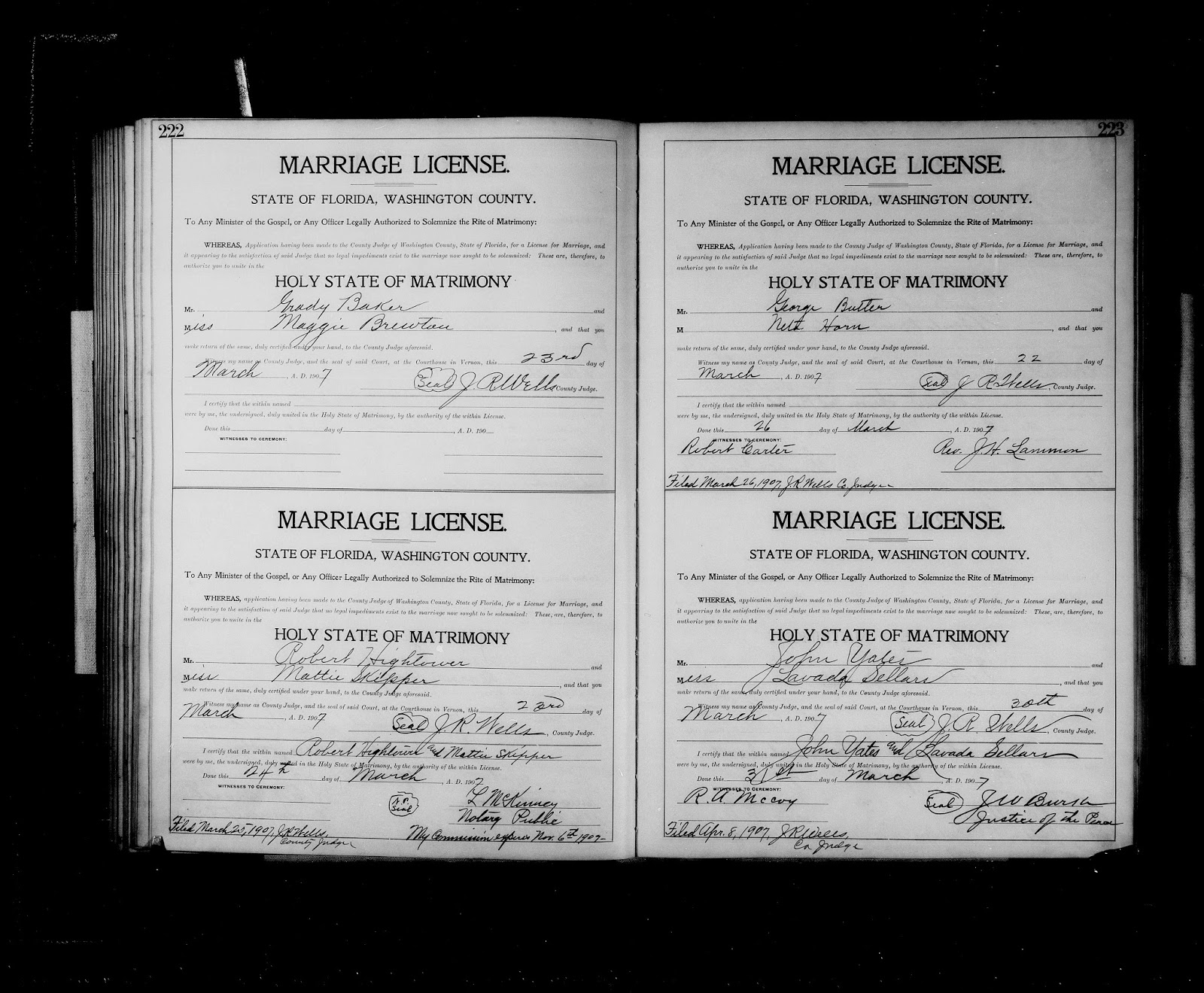
Copies or photographs of originals are what you need for your ancestor hunt.  Here is an example of a marriage record.  Be aware that records will vary from place to place.  Some contain only the basics, others have the name of the father and mother of the groom and the bride and other details.

As you see, some marriage records like this one, appear on a page with other records!  How do you know when you have found your ancestor/relative?  What source material or information do you need to cite the source?  Why is it important to source the records.


Another Example of Marriage Record:


A marriage record is generated at the time of the event (or thereabouts) and in the lifetime of the primary actors.  This is as good as it gets.


When I was Young! Tennis Interview

  I may have been a little bit precocious at the age of 15 or 16.  But I didn't let that stop me!   While Northwest Florida might have b...